
The Origins of Indigo Salt
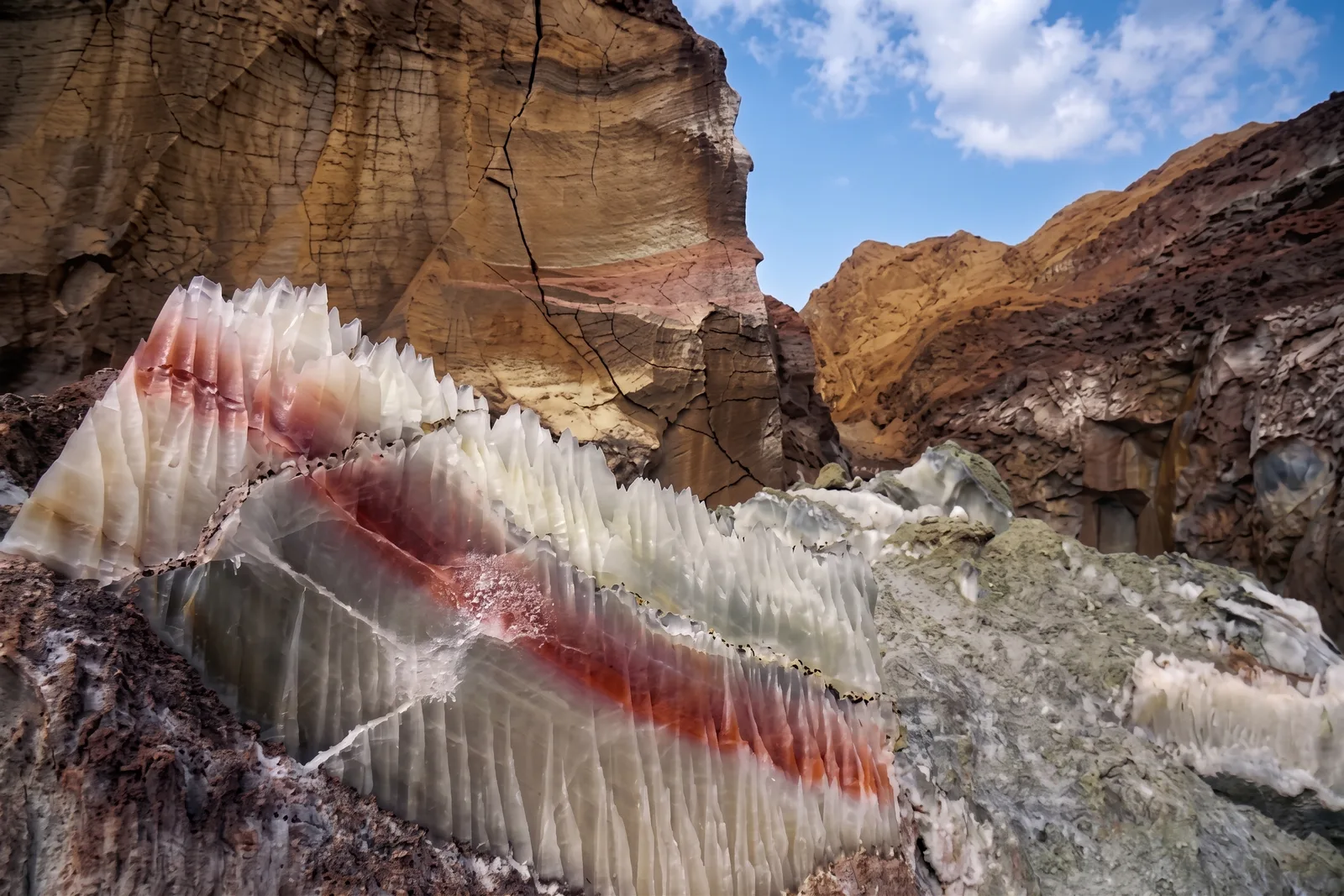
Indigo Salt is a rare natural blue rock salt. Its shimmering inclusions range from a pale, aquamarine blue to deep, sapphire-like shades. The colour is what first draws the eye.
It is sourced from a small number of natural salt deposits around the world, including New Mexico in the United States and Saskatchewan in Canada. These deposits were left behind by ancient seas more than 100 million years ago and have rested deep underground ever since. Every source is examined and selected through our research and development in Sweden.
The salt is rare because it does not occur in large blocks. The blue runs only in narrow veins, roughly 20 to 30 centimetres wide, threaded through the surrounding rock salt. The material has to be separated carefully by hand, and around 100 kilograms of raw rock is broken down to yield about one kilogram of pure blue salt. That difficulty is why it costs far more than ordinary salt.
The veins formed over millions of years as tectonic pressure deformed the crystal lattice of the salt. That distortion changes the way light passes through the crystal, so it reaches the eye as blue, and sometimes as violet, grey or pink. Chemically, common table salt is sodium chloride, while blue salt also carries a notable proportion of potassium chloride, the mineral sylvite, which contributes to both its colour and its flavour.
In the kitchen, Indigo Salt tastes just like regular salt, so you can use it anywhere you would use ordinary salt. It suits fish, meat, seafood, potatoes, salads and vegetables, and is often used as a finishing salt just before serving, or at the table in a mill or a bowl. Coarse grains stay whole until they dissolve on the palate.
A simple way to judge authenticity is to crush a grain. A genuine crystal loses most of its colour and turns to a whitish powder, because the colour lives inside the crystal structure rather than on its surface. Grains that stay vividly blue once ground are usually dyed or blended imitations, and much of the blue salt sold elsewhere is mixed with sea salt and may be only 15 to 20 per cent blue salt.